The Organic Label and the Laboratory: What Residue Testing Reveals About Pesticide-Free Claims

Photo: Lands Department, Survey Office, Cartographic Branch, Photographic Section, Public domain, via Wikimedia Commons
For millions of American households, the USDA Organic seal functions as a shorthand for safety. It signals that a product was grown without the application of synthetic pesticides, manufactured fertilizers, or genetically modified organisms. The certification process is not trivial — growers must document their practices, submit to periodic inspections, and maintain detailed records. Yet when produce bearing that seal is submitted to an independent analytical laboratory for chemical residue screening, the results do not always align with the label's implicit promise.
This is not a fringe phenomenon. Periodic surveys conducted by federal agencies and independent research organizations have found detectable synthetic pesticide residues on a statistically significant portion of certified organic produce. Understanding why this occurs, and how laboratory analysis differs from certification oversight, is essential for anyone who has made purchasing decisions based on the assumption that organic means pesticide-free.
What Organic Certification Actually Guarantees
It is worth being precise about what the USDA National Organic Program (NOP) certification does and does not certify. The program regulates agricultural practices — the inputs a farmer is permitted to use, the land management protocols required, and the documentation that must accompany each harvest. It does not certify a chemical outcome. In other words, a grower can be in full compliance with organic standards and still produce crops that test positive for synthetic compounds.
Several pathways exist for this outcome. Pesticide drift from neighboring conventional operations is among the most commonly documented. Wind-carried spray can deposit residues on organic fields with no action or negligence on the part of the certified grower. Contaminated irrigation water represents another vector, particularly in agricultural regions where waterways pass through or alongside conventionally farmed land. Shared equipment, post-harvest handling environments, and packaging materials can also introduce trace contamination at stages well downstream from the field itself.
Fraud, while less common than environmental contamination, is also a documented concern. Investigations by the USDA's Agricultural Marketing Service have identified cases in which grain and produce were fraudulently marketed as organic despite originating from conventional operations. For the end consumer, the label alone provides no mechanism to distinguish between a compliant product that encountered environmental contamination and one that was mislabeled at the source.
The Analytical Gap Between Audits and Laboratory Testing
Certification audits are fundamentally document reviews. An inspector evaluates purchase records, field maps, input logs, and handling protocols. They may walk the operation and conduct interviews. What they cannot do is detect the presence of a chemical compound at the parts-per-billion level — that capability belongs exclusively to the laboratory.
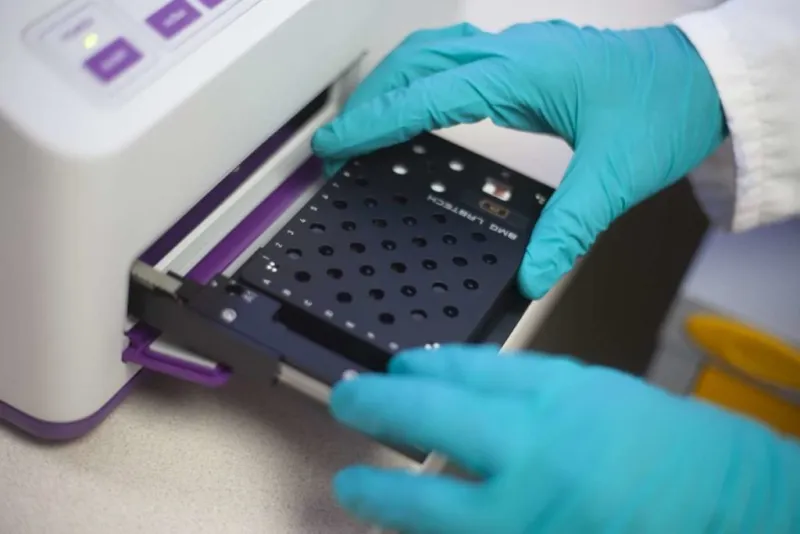
Modern pesticide residue analysis relies on multi-residue screening methods, most commonly gas chromatography-mass spectrometry (GC-MS) and liquid chromatography-tandem mass spectrometry (LC-MS/MS). These platforms can simultaneously screen a single produce sample for several hundred distinct compounds, identifying and quantifying residues at concentrations far below the thresholds detectable by any field inspection. A strawberry that appears visually pristine, carries full documentation, and passed its most recent audit can still yield a positive result for chlorpyrifos, permethrin, or spinosad when subjected to this level of analytical scrutiny.
The sensitivity of these methods is significant. Regulatory tolerance levels established by the EPA are expressed in parts per million, but laboratory detection limits routinely reach parts per billion or lower. This means that residues present at concentrations orders of magnitude below regulatory action thresholds are nonetheless detectable — a distinction that has important implications for how consumers interpret positive findings.
Interpreting Positive Results: Detection Versus Risk
A positive residue detection on an organic sample is not automatically a health emergency, and responsible communication of laboratory data requires careful framing. The presence of a compound at 0.003 parts per million is a chemically meaningful finding; whether it represents a meaningful health risk depends on the specific compound, the exposure frequency, the quantity consumed, and the population in question — particularly children, pregnant individuals, and those with compromised metabolic function.
Nonetheless, detection matters for several reasons. First, it demonstrates that the assurance implied by the organic label is probabilistic rather than absolute. Second, certain compounds warrant concern even at low concentrations — endocrine-disrupting chemicals, for instance, are the subject of ongoing toxicological research that questions the adequacy of tolerance thresholds established under older risk frameworks. Third, cumulative exposure across multiple food sources may aggregate to levels of greater significance than any single item would suggest.
For consumers who have selected organic produce specifically to minimize pesticide exposure, knowing that the label does not guarantee a zero-residue outcome is foundational information. It shifts the conversation from binary thinking — organic equals safe, conventional equals risky — toward a more nuanced understanding of risk reduction rather than risk elimination.
What Independent Testing Can Reveal That Labels Cannot
Submitting produce samples to an accredited analytical laboratory provides a level of verification that no certification audit can replicate. A comprehensive multi-residue panel on a representative sample set will identify which compounds, if any, are present, at what concentrations, and — when compared against known compound profiles — can sometimes suggest whether contamination is consistent with drift exposure or more direct application.
For food businesses, distributors, and retailers who source organic products, third-party residue testing serves as a supply chain verification tool that complements, rather than replaces, certification documentation. A supplier who can provide both organic certification and clean laboratory results offers a materially stronger quality assurance position than one who provides documentation alone.
For individual consumers, access to laboratory testing is more limited but not nonexistent. Some laboratories accept direct consumer submissions, and several independent nonprofit organizations publish annual residue testing data on commonly purchased produce items. Consulting those databases — while understanding their methodological scope and sampling limitations — can inform purchasing priorities even without commissioning bespoke analysis.
Practical Guidance for Produce Purchasers
Several evidence-based practices can meaningfully reduce dietary pesticide exposure regardless of certification status. Thorough washing under running water removes a portion of surface residues on both organic and conventional produce, though it does not address systemic compounds absorbed into the plant tissue. Peeling removes additional surface contamination where the texture of the produce permits it without significant nutritional loss.
Prioritizing organic purchases for items that consistently show higher residue burdens in surveillance data — strawberries, spinach, bell peppers, and peaches have historically appeared near the top of such lists — while accepting conventional options for produce with naturally protective outer layers represents a cost-conscious approach to risk reduction.
Perhaps most importantly, understanding that the organic seal reflects a production standard rather than a laboratory-verified chemical outcome recalibrates expectations in a useful direction. Organic agriculture, on balance, does result in lower average residue burdens compared to conventional production. The distinction is one of probability and magnitude, not categorical absence.
The Role of Analytical Science in Food Transparency
Certification systems serve a legitimate and valuable function in agricultural markets. They create accountability frameworks, establish baseline standards, and provide consumers with a navigable shorthand in a complex marketplace. But they are not substitutes for analytical verification, and the data generated by independent laboratory testing consistently demonstrates that the gap between certification and chemical reality is real, if often narrow.
At Keystone Labs, residue analysis is approached with the same methodological rigor applied across all analytical disciplines: validated methods, appropriate detection thresholds, and results interpreted within their proper scientific context. The value of that work lies not in undermining consumer confidence in organic agriculture, but in providing the kind of precise, evidence-based information that allows individuals, businesses, and policymakers to make decisions grounded in what the science actually shows — rather than what a label implies.